
What Are Bitcoin Mining Rewards?

Bitcoin mining rewards are the BTC you earn from validating blocks (the fixed subsidy of 3.125 BTC post-2024 halving plus transaction fees), typically received via a mining pool and paid out to you or your hosting account in line with the pool’s payout model (e.g., FPPS, PPS+, PPS, PPLNS), your contributed hashrate, uptime, fees, payout thresholds and critically in Australia your electricity tariff, hardware efficiency (J/TH), server latency and tax position.
In a hosted context, “Bitcoin mining rewards” are not some mysterious bonus your hosting company “gives” you. They’re the network’s native incentives paid to miners: the block subsidy plus transaction fees included in each block. Since Bitcoin’s fourth halving, the subsidy is 3.125 BTC per block.
Most hosted miners do not mine solo. Instead, your ASIC points its hashrate at a mining pool, and the pool distributes payouts based on your contributed work (“shares”), your pool’s payout method (e.g., FPPS vs PPLNS), and real-world frictions such as:
- Pool model and pool fees
- Facility uptime and your miner’s “effective hashrate.”
- Stale/reject rate (often driven by latency and network quality)
- Electricity tariff (the number one driver of net profit)
- Hardware efficiency (J/TH) and tuning profiles
- Cooling performance and thermal throttling
- Payout thresholds and payout cadence
- Australian tax treatment (ATO reporting at receipt)
Hosting adds operational layers that can materially increase the rewards you realise versus what you “should” earn on paper especially in Australia, where household electricity is often expensive relative to industrial rates.
Bitcoin rewards 101:
How miners get paid: subsidy + fees
When miners find a valid block, the miner (or pool) claims rewards through the block’s coinbase transaction, which includes:
- Block subsidy (new BTC issued by the protocol)
- Transaction fees from transactions included in that block
After the 2024 halving, the subsidy is 3.125 BTC. Transaction fees fluctuate: in quiet period,s they’re modest; during congestion (mempool backlogs or “on-chain crazes”), fees can spike and materially increase per-block revenue.
The role of difficulty:
Bitcoin aims for ~10-minute blocks on average. The network adjusts difficulty every 2,016 blocks (roughly two weeks) to keep block time near target even as total network hashrate rises or falls.
That’s why hosted miners obsess over “hashprice” (revenue per TH/s per day): it compresses the combined effects of:
- BTC price
- Transaction fee market
- Network difficulty / hashrate
Hosting customers should understand that your daily BTC earned can fall even if your machines run perfectly because the network got more competitive, difficulty rose, or fees cooled.
Comparing hosting versus self-mining in Australia
Below is a practical comparison for Australians deciding between Bitcoin miner hosting (for example, using a provider such as Mining Store) and running ASICs at home.
| Factor | Hosting (e.g. Mining Store) | Self-Mining at Home |
| Electricity Costs | Industrial rates as low as $0.12–$0.18/kWh | Residential rates often $0.30–$0.40/kWh |
| Uptime & Cooling | 98–99% uptime, professional cooling systems | Risk of overheating, downtime |
| Noise & Regulation | Hosted in industrial zones | Residential mining often restricted |
| Maintenance | Managed by technicians | DIY troubleshooting |
| Scalability | Easy to add units | Limited by home power capacity |
| Profitability | More stable, predictable | Highly variable |
| Support | 24/7 operations team | Self-managed only |
What this means for realised mining rewards
Mining Store, for example, publicly markets a hosted power-and-hosting rate of 12 cents AUD/kWh for its EU facility (aimed at Australian customers), explicitly contrasting this with higher typical Australian household pricing.
Why almost everyone uses mining pools
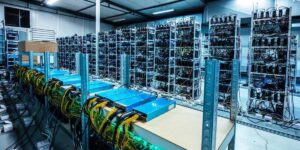
Solo mining is a lottery; pools convert it into cash flow
At today’s network competition levels, solo mining is statistically impractical for all but extremely large operators. A mining pool pays you proportionally for valid shares you submit, smoothing variance so you can forecast revenue against:
- monthly power and hosting invoices,
- hardware finance payments,
- Treasury needs (e.g., stacking BTC vs converting to AUD).
Why do hosted miners benefit even more
Hosted miners in Australia (or Australian customers hosting offshore) typically gain:
- Lower variance with PPS/FPPS—better for matching fixed operating costs.
- Operational simplicity (the pool handles templates, block-building, payout accounting).
- Access to latency-aware endpoints (APAC nodes) to reduce stale shares.
The trade-offs are real:
- Pool fees (often ~0.5%–4%, depending on model and services).
- Operator trust and counterparty risk (you’re owed payouts by the pool).
The payout models that determine what lands in your wallet
Pool payout methods are not cosmetic they directly shape cash flow, volatility, and how much of the fee market you capture.
PPS (Pay-Per-Share)
PPS pays a fixed amount for each valid share you submit, regardless of whether the pool finds blocks in the short term.
- Best for: stability
- Typical downside: higher fee; may not include transaction fees (policy varies by pool)
FPPS (Full Pay-Per-Share)
FPPS is PPS plus an average share of transaction fees.
- Best for: maximum predictability for hosted miners paying fixed bills
- Commonly offered by large pools (availability varies by jurisdiction/provider)
PPS+ (Pay-Per-Share Plus)
PPS+ pays the subsidy component PPS-style, but shares transaction fees using a PPLNS-style mechanism.
- Best for: steady baseline plus fee upside
- Downside: the fees component still has variance
PPLNS (Pay-Per-Last-N-Shares)
PPLNS pays only when the pool finds blocks; your payout depends on your shares in the most recent “N” share window.
- Best for: miners who can tolerate payout volatility and run continuously
- Downside: unpredictable cash flow; punishes downtime (miss the window, miss the payout)
Proportional / score-based variants
Legacy methods are used by some pools. Score-based systems down-weight “pool-hopping” and often behave similarly to PPLNS in practice.
Why to choose in Mining Store Australia

If you want a predictable daily settlement
If you can accept variance for potential long-run parity
Choose PPLNS but only if your hosting uptime is excellent and your stale rate is low. Otherwise, the theoretical advantage gets eaten by operational reality.
Pros and cons of each payout model
FPPS
Pros
- Predictable revenue and easier budgeting
- Includes fee component (averaged)
- Often easiest for tax capture at receipt (regular, time-stamped payments)
Cons
- Typically higher pool fee
- Depends on the pool’s fee estimation and accounting integrity
PPS+
Pros
- Stable base plus upside when fees surge
- Good blend for portfolio approaches (e.g., split fleet strategies)
Cons
- Fees still variance-exposed
- Timing windows matter
PPS
Pros
- Steady income
- Simple to model
Cons
- Often leaves fee revenue on the table versus FPPS/PPS+
PPLNS
Pros
- Often the lowest fee
- Can outperform during “lucky” streaks
- Discourages pool-hopping; aligns miners with pool health
Cons
- Unpredictable payouts (can mismatch hosting invoices)
- First meaningful payout can be delayed depending on N window and hashrate
Calculating hosting ROI in Australia using a Bitcoin profitability calculator
A profitability calculator is only as good as your inputs. For Australian hosting, model ROI using these real-world variables:
Step-by-step: modelling a hosted ASIC

- Enter your ASIC miner specs (example: 200 TH/s).
- Enter power draw in kW (e.g., 3.5–3.7 kW depending on configuration).
- Input hosted electricity rate (example: A$0.15/kWh; some providers advertise A$0.12/kWh in certain facilities).
- Choose pool model and fee (example: FPPS, 2.5%).
- Add the current BTC price and the current network difficulty (or use hashprice if the tool supports it).
- Review outputs: daily BTC mined, AUD revenue, power cost, hosting fees, net profit, and break-even BTC price.
Sensitivity (simple but powerful)
- +10% BTC price → ~+10% revenue (all else equal)
- +10% difficulty → ~−10% BTC yield (all else equal)
- +A$0.02/kWh → can materially compress margin (especially post-halving)
Use your host’s tool if available (many providers publish dashboards), and sanity-check with external calculators like ASIC-spec sites that list typical power/efficiency for the same model.
Beyond the big four: fixed & upfront payout structures
In tighter post-halving margins, some institutional products aim to stabilise revenue:
Fixed payouts (locking a forward hashprice)
You agree to deliver a defined hashrate for a period (e.g., 3–12 months) and receive a fixed BTC-denominated payout rate. This reduces exposure to:
- difficulty increases,
- fee market drops,
- short-term volatility.
Upfront payouts (monetising future hashrate today)
Some arrangements exchange future hashrate delivery for immediate capital—useful for:
- funding ASIC upgrades,
- expanding capacity without equity dilution,
- smoothing treasury planning.
Operational considerations:
- Contract term and delivery obligations
- Integration with your host’s uptime SLA and metering
- Counterparty risk (read the contract like a power purchase agreement)
How rewards are calculated and paid to hosted miners (step-by-step)
The full flow for a hosted ASIC in Australia
- Your ASIC miner submits shares to the pool under your worker name.
- The pool values those shares using FPPS/PPS+/PPS/PPLNS rules.
- Pool fee is deducted; transaction fees are included or not, depending on the model.
- A minimum payout threshold applies (e.g., 0.0002–0.01 BTC varies widely by pool/account settings).
- Payout is sent to your nominated BTC wallet (or to a hosting account arrangement if you opted in).
- For accounting, you export time-stamped receipts (and/or pool statements).
What reduces realised rewards
- Stale shares (submitted too late)
- Rejects (bad shares, misconfiguration, overheating)
- Downtime (maintenance, faults, thermal trips)
- Latency to pool servers
- Orphan/stale blocks (rare, but real at network level)
Understanding Bitcoin halving and its direct impact on mining rewards

How halving works
Bitcoin’s halving occurs every 210,000 blocks (roughly four years). It cuts the block subsidy in half.
Subsidy evolution
- 50 → 25 → 12.5 → 6.25 → 3.125 BTC (current epoch since the 2024 halving)
Why halving matters more for hosted miners
Halving immediately reduces the subsidy component of revenue, forcing miners to rely more on:
- transaction fees,
- superior ASIC efficiency (J/TH),
- low-cost and reliable operations (power + uptime).
This is exactly where professional hosting can be a competitive advantage: better cooling, higher uptime, lower power pricing, and less operational chaos—especially through Australian summer conditions.
Hardware efficiency and fleet tuning: why J/TH is the new king of rewards
For hosted miners, efficiency (Joules per terahash, J/TH) often matters more than raw hashrate, because power is your dominant ongoing cost.
Modern ASIC classes and cooling profiles
Newer-generation ASIC miners such as Bitmain’s S21 line are marketed around the ~200 TH/s class, with wall power figures that vary by source/configuration. Bitmain’s official S21 spec lists 200 TH/s at 3500 W at 25°C (about 17.5 J/TH), while some resellers quote different wall power numbers depending on their configuration assumptions.
Cooling approaches in hosting:
- Air cooling (most common)
- Hydro/“water” cooling (in specific halls)
- Immersion cooling (excellent thermals; requires facility support)
Tuning strategy across the hashprice cycle
- Underclock/low-power profiles when hashprice dips → better J/TH, lower OPEX, steadier margins.
- Overclock during fee spikes/BTC rallies → accept worse J/TH for higher gross output when it pays.
This must align with hosting policies: rack power envelopes, heat density limits, and the facility’s SLA.
The Australian power equation: tariffs, renewables, curtailment and grid programmes
Australian power economics are complicated, but your mining outcome is not: your break-even is brutally sensitive to $ / kWh.
What matters in practice
- Time-of-use tariffs (peak vs off-peak)
- Behind-the-meter renewables (solar/wind/hydro proximity)
- Curtailment/demand-response arrangements (power down during peaks for credits)
Some providers explicitly market renewable-powered sites and low power rates (including offshore facilities for Australian customers). Meanwhile, published large-business default energy rates can show low cents/kWh energy components in some states/periods (often excluding additional charges), illustrating why industrial procurement can beat household pricing.
For miners, these inputs change which pool model fits. If your costs are stable and known, FPPS is easier to match to bills. If your costs vary (time-of-use or curtailment), variable revenue models can amplify mismatch risk.
Latency and server proximity: squeezing extra rewards from lower stales
Latency is a silent leak in mining revenue.
Why it matters
If your share arrives late (or your miner is working on a template that’s just been superseded), you produce stale shares—work that earns less or nothing, depending on pool rules.
Practical steps for Australians
-
- Use APAC stratum endpoints (where available: Singapore, Japan, Oceania endpoints depending on pool)
- Configure failover servers (primary + secondary + tertiary)
- Ensure redundant uplinks at the facility
- Monitor: accepted shares, stale %, reject spikes, and time-to-submit
Even a 0.5%–1.0% improvement in stale rate compounds meaningfully over months, especially across multiple units.
Choosing a pool from Australia: criteria that affect your bottom line
Don’t pick a pool solely on the headline fee. Use a checklist:
Pool selection checklist
-
- Payout method (FPPS/PPS+/PPS/PPLNS) and exact fee policy (are fees passed through?)
- Minimum payout threshold vs your hashrate (small rigs hate high thresholds)
- Payment cadence (daily/weekly) and wallet options
- Transparency and dashboards (real-time share stats, luck, blocks, incidents)
- Server geography (APAC nodes) and DDoS posture
- Reputation and support responsiveness
- Tooling/APIs (for host portals and ATO records)
- Compliance stance (KYC/AML considerations for institutions)
- Stratum roadmap (e.g., Stratum V2 readiness if relevant to your operation)
Pool fees, payout thresholds, and hidden frictions that erode rewards
Typical frictions to watch
- Pool fee bands (often ~0.5%–4%)
- Thresholds (funds sitting on the pool can become counterparty risk)
- Withdrawal fees (policy-specific)
- “Stale share” policies (some pools penalise more aggressively)
- Poor endpoints (higher latency → higher stale → lower net)
A best practice is to A/B test two pools: route 10–20% of hashrate to a second pool for 48–72 hours and compare:
- net payout per TH,
- stale rate,
- payout arrival time in the wallet.
Then scale the winner.
Australian tax treatment and record-keeping
This is general information only—get advice for your situation.
What the ATO broadly focuses on (mining context)
The ATO provides guidance on crypto assets in business and specifically on crypto mining.
Common operational implications include:
- Income at receipt: Mining rewards are typically treated as income when received (record the AUD market value at the time of receipt).
- Subsequent disposals: If you later sell/swap the mined BTC, you calculate gains/losses relative to your recorded cost base.
- Business vs hobby: Hosted operations often look more like a business (especially with scale and systematic intent), which affects deductions and record-keeping expectations.
- Records matter: Wallet receipts, pool statements, hosting invoices, and exportable logs are your compliance backbone.
If your pool/host offers APIs and time-stamped reports, use them; it turns tax season from chaos into reconciliation.
Operational best practice for Australian hosting: uptime, cooling, firmware, safety

Your theoretical rewards only become real rewards with operational discipline:
Uptime and preventive maintenance
- Scheduled maintenance windows with clear SLAs
- Spare parts strategy (fans/PSUs/hashboard access)
Cooling matched to climate
- Air-cooled halls need proper intake/exhaust, filtration, and hot-aisle management
- Immersion/hydro can stabilise temps through extreme heat (if facility supports it)
Power quality and safety
- Surge protection and power quality monitoring
- Avoid running near breakers’ limits; heat + load is unforgiving
Firmware governance
- Approved profiles (baseline low-power + event-driven boost)
- Rollback plans if instability appears
Network redundancy and security
- Dual ISP where possible
- Stratum failover configuration
- 2FA on pool accounts, address whitelisting, restricted access
Monitoring and alerting
- Hashrate deviation alerts
- Reject/stale spikes
- Temperature alarms
Risk management: centralisation, DDoS, operator trust, and pool-hopping
Centralisation and operator risk
A handful of pools can command large shares of global hashrate at times. Diversifying across two reputable pools can:
- hedge operational outages,
- reduce counterparty exposure,
- support network health.
DDoS and outages
Prefer pools with multi-region failover and strong mitigation; ensure your host has redundant network paths.
Pool-hopping disincentives
PPLNS and score-based models often discourage hopping. If you switch pools frequently, understand how that affects your payout window.
Environmental and social considerations relevant to Australia (why they still affect rewards)
Higher energy prices and ESG scrutiny mean the “green” question is also a profit question. Hosting near abundant solar/wind/hydro, or participating in curtailment programmes, can reduce effective $ / kWh and keep hosting tariffs competitive—protecting your net rewards across cycles.
Understanding ASIC miner technology and why it matters for rewards
What is an ASIC miner?
An ASIC (Application-Specific Integrated Circuit) is purpose-built hardware optimised to perform SHA-256 hashing (Bitcoin’s proof-of-work function). That’s why ASIC miners dominate Bitcoin mining, while GPUs/CPUs are uncompetitive for SHA-256 at scale.
Performance metrics that matter
- Hashrate (TH/s): your raw contribution to the pool
- Power draw (W): your operating cost driver
- Efficiency (J/TH): your profitability edge in higher-cost power markets like Australia
Common major brands include Bitmain, MicroBT, and Canaan.
Product highlight: Bitmain Antminer S21 200TH/s — hosted or shipped via Mining Store Australia
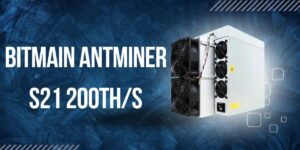
Overview
- Algorithm: SHA-256 (Bitcoin)
- Hashrate: 200 TH/s
- Power consumption: reseller listings may quote around 3725 W for the hosted/shipped SKU, while Bitmain’s specification lists 3500 W @25°C (configuration and measurement conditions can vary).
- Price: A$6,999 plus GST for the shipped listing (hosted units may have different tax treatment as described by the provider).
- Availability: “Hosted” or “Shipped” options listed by the provider.
Hosted option (as advertised by the provider)
Mining Store’s product page states that for “Hosted” miners, units are shipped to their EU data centre with an indicated 3–4 week timeframe after payment confirmation.
Shipped option (as advertised by the provider)
For “Shipped” orders, the same listing states dispatch via FedEx/DHL/UPS within 5–7 business days after payment confirmation.
Why the S21 class fits the Australian hosting market
- Strong efficiency profile for tighter post-halving margins (lower J/TH generally wins)
- Works well with FPPS strategies for predictable settlement
- Better thermals and managed environments reduce throttling and downtime (hosting advantage)
A concise glossary for first-time hosted miners (Australia-friendly)
- Block subsidy: Newly minted BTC per block (3.125 BTC since the 2024 halving).
- Transaction fees: User-paid fees included in a block; volatile.
- Hashrate / TH/s: Mining speed; more = more shares.
- J/TH: Efficiency metric (lower is better).
- Share: Proof of contributed work for pool accounting.
- Stale share: Late share; earns less or nothing.
- FPPS / PPS+ / PPS / PPLNS: Pool payout models.
- Hashprice: Revenue per unit of compute, shaped by BTC price, fees, and difficulty.
- Threshold: Minimum BTC before a pool pays your wallet.
Conclusion: aligning your payout model with Australian hosting (and why Mining Store matters)
If you’re hosting from Australia, your Bitcoin mining rewards depend as much on operational discipline and smart pool selection as on the ASIC miner you buy. Matching a payout model to your cash-flow needs (FPPS/PPS+/PPLNS), minimising stales with APAC endpoints, tuning for best-in-class J/TH, and keeping clean ATO-grade records at receipt are the practical levers that protect and grow your BTC income after the 2024 halving.
To make those levers easier to pull, choose a hosting partner that understands the power, cooling, connectivity, and reporting realities Australian miners face. Mining Store markets low-cost hosted power, hands-free setup, and on-site support alongside hosted/shipped pathways for modern ASICs like the S21 so you can focus on strategy rather than firefighting.