
What is a Self Managed Super Fund

A self managed super fund is a private superannuation fund, structured as a trust, whose members generally act as its trustees or as directors of its corporate trustee. The ATO regulates the fund, while the trustees make its investment decisions and remain personally responsible for compliance.
An SMSF can have up to six members. It is governed by its trust deed, the Superannuation Industry Supervision Act 1993, associated regulations and tax law. Trustees must act for the purpose of providing retirement or death benefits, keep assets separate, prepare and regularly review a written investment strategy, maintain records and arrange an independent annual audit.
The ATO March 2026 quarterly SMSF report recorded 672,805 SMSFs with 1,239,977 members and estimated sector assets of about $1.06 trillion. Those numbers show that SMSFs are a substantial part of Australian superannuation, but they do not show that an SMSF is suitable for any particular investor.
That control is the reason direct Bitcoin mining can be considered. An ordinary industry or retail super fund decides which investments members can access, whereas an SMSF can own specific equipment and digital assets where its governing rules allow it. The trade off is that members carry the administrative workload, cost and legal responsibility themselves.
The Moneysmart SMSF guide warns that trustees may spend more than eight hours a month managing their fund. SMSF members also do not receive the same government compensation arrangements that may apply to APRA regulated funds following theft or fraud, and disputes about an SMSF generally cannot be taken to the Australian Financial Complaints Authority.
| Feature | SMSF | Industry or retail super fund |
|---|---|---|
| Investment decisions | Made by members as trustees | Made within options selected by the fund |
| Regulator | ATO | APRA, with ASIC overseeing financial services and conduct |
| Direct mining hardware | Potentially available if compliant | Generally unavailable to individual members |
| Administration | Trustees arrange records, tax and audit | Managed by the fund |
| Legal responsibility | Trustees or corporate trustee directors | Fund trustee and service providers |
| Time and cost | Can be substantial | Usually reflected in disclosed fund fees |
Learning the difference between holding a crypto asset and operating a mining activity is an essential first step. Structured crypto education through the Crypto Academy can help trustees understand the underlying asset before they consider the superannuation structure.
Bottom line: An SMSF offers control, not an exemption from the rules. Mining is only suitable when the trustees can manage both the investment and the compliance burden.
What Bitcoin Mining Is and How It Works
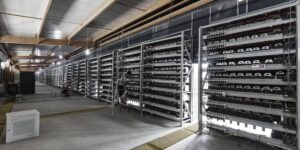
Bitcoin mining is the process in which specialised computers compete to validate transactions and add a block to the Bitcoin blockchain. A successful miner receives the block subsidy and the transaction fees in that block.
Bitcoin uses proof of work. Mining machines repeatedly hash block data using the SHA 256 algorithm. A valid block hash must fall below a target set by the network. Finding it is a probability contest, so more hashrate means more attempts and a greater expected share of rewards, but never a guaranteed reward.
The mining cycle
- Bitcoin transactions are broadcast to the network.
- A miner or mining pool assembles eligible transactions into a candidate block.
- ASIC machines perform trillions of SHA 256 calculations each second.
- A miner finds a valid result and broadcasts the block.
- Bitcoin nodes check the proof of work and every transaction.
- Once accepted, the block becomes part of the blockchain and the reward is paid to the winning miner or pool.
The protocol targets one block about every ten minutes. More network hashrate generally raises difficulty over time, making the same machine earn fewer Bitcoin unless other factors change.
The April 2024 halving reduced the block subsidy from 6.25 BTC to 3.125 BTC. At 144 blocks a day, the theoretical subsidy issuance is about 450 BTC a day, although actual block timing varies and miners also receive transaction fees. Mempool network data showed approximately 933 EH/s of hashrate and a difficulty of 127.5 trillion on 19 August 2026. These figures change continuously and should be refreshed before publication and before any investment decision.
Modern Bitcoin mining requires application specific integrated circuit machines, known as ASICs. A desktop computer or ordinary graphics card cannot compete efficiently with specialised SHA 256 equipment. This distinction matters to an SMSF because the fund is not buying a general computer. It is buying a depreciating, single purpose business asset whose output and resale value depend on network conditions.
Bottom line: Mining converts electricity and specialised computing power into an expected flow of Bitcoin. Price, difficulty, machine efficiency, uptime and operating cost determine the result.
Whether to Mine Bitcoin or Simply Buy It Inside an SMSF
Buying Bitcoin is the simpler way for an SMSF to obtain price exposure. Mining is an operating activity that can build a Bitcoin holding over time, but it introduces hardware, energy, service provider, accounting, tax and audit obligations.
The right comparison is not merely whether mining produces Bitcoin at less than today’s market price. Trustees must compare the full expected return, risk and workload of each option against every reasonable alternative available to the fund.
| Issue | Buy and hold Bitcoin | Mine Bitcoin |
|---|---|---|
| Upfront outlay | Bitcoin purchase and custody setup | Hardware, installation, hosting deposit and working capital |
| Ongoing costs | Custody, exchange and administration | Electricity, hosting, pool fees, repairs, tax and administration |
| Operational work | Low after secure custody is established | Continuing monitoring, reconciliation and supplier management |
| Tax character | Usually a CGT asset when held as an investment | May be trading stock where mining is a business |
| Main drivers | Bitcoin price | Bitcoin price, difficulty, fees, hashrate, uptime and power cost |
| Asset decline | Bitcoin price can fall | Bitcoin price can fall and hardware can become obsolete |
| Liquidity | Generally straightforward through an exchange | Bitcoin may be liquid, but hardware may take time to sell |
| Audit evidence | Wallet, exchange, valuation and ownership records | All buying records plus hardware, hosting, pool and business records |
A fund that simply wants Bitcoin exposure may achieve that purpose more directly by buying through an AUSTRAC registered exchange and moving the asset to a fund controlled wallet. Mining may suit trustees who deliberately want exposure to Bitcoin production, understand the operational risk and can document why it is expected to improve the fund’s retirement outcomes.
The tax distinction requires care. Bought Bitcoin held as an investment is generally a CGT asset. Where the mining activity constitutes a business, the ATO says mined crypto assets are trading stock. Trustees should not build a model on an assumed CGT discount for mined coins until a registered tax agent has confirmed the fund’s treatment.
Readers who want to understand buying, custody and market risk can learn how to invest in cryptocurrency. Those evaluating the operational route can discuss hosted Bitcoin mining with Mining Store Australia.
Bottom line: Choose mining only when its expected after tax return and strategic role justify the additional cost, risk and administration compared with buying Bitcoin or using a diversified super portfolio.
Whether an SMSF Can Legally Mine Bitcoin in Australia

An SMSF can legally mine Bitcoin in Australia because superannuation law does not specifically prohibit crypto mining. The activity is only acceptable where the trust deed allows it, the investment strategy supports it and the way it is conducted complies with every applicable superannuation rule.
The practical gateways are:
- The trust deed does not prohibit digital assets, mining, business activities or the relevant contracts.
- The trustees adopt an investment strategy that considers mining’s return, risk, liquidity, diversification and ability to meet liabilities.
- The fund, through its trustee, owns the hardware and associated contractual rights.
- Wallets, exchange accounts, pool accounts and proceeds are clearly attributable to the fund.
- Purchases and services occur on commercial, arm’s length terms.
- Members and related parties receive no present day benefit.
- Borrowing, charges over assets and related party acquisitions comply with the SIS Act.
- The fund maintains evidence for its accountant and independent auditor.
The word legally should not be confused with suitable. A permitted activity may still be unsuitable for a fund with low liquidity, older members, pension obligations or a concentrated investment strategy. It may also become noncompliant if the trustees use a member’s home electricity without a defensible contract, mix fund Bitcoin with personal Bitcoin, or allow a member to use fund owned equipment.
The ATO has specific guidance on SMSFs investing in crypto assets, while Taxation Determinations TD 2014/25 and TD 2014/26 address Bitcoin as a CGT asset and as trading stock in a busines.
Bottom line: Yes, an SMSF can mine Bitcoin, but only through a deliberately designed and continuously documented structure.
How the Sole Purpose Test Applies to Bitcoin Mining in an SMSF
The sole purpose test requires an SMSF to be maintained for providing retirement benefits to members, or death benefits to their dependants or legal personal representatives. A bitcoin mining arrangement must serve that purpose and must not provide members with a current personal benefit.
Section 62 of the SIS Act is the central rule. Trustees should be able to show that every material decision was made to improve the fund’s retirement outcome on a risk adjusted basis. A personal enthusiasm for Bitcoin is not enough.
Conduct that supports the retirement purpose
- The fund owns the ASIC and receives all mining proceeds.
- The investment strategy documents expected return, costs, risk and exit arrangements.
- Hosting, repairs and pool services are acquired on commercial terms.
- The fund pays its own expenses directly from its bank account.
- Trustees review actual results against the original case and change course when necessary.
- Members have no personal access to or use of the fund’s hardware or Bitcoin.
Conduct that creates concern
- A member uses the miner to heat a home, powers it through a personal electricity account without a commercial agreement, or mines personal coins with fund equipment.
- The fund overpays a related business for hosting or maintenance.
- A wallet contains both fund and personal assets.
- Trustees keep loss making machines running mainly because they enjoy the activity.
- The arrangement gives a member access to super before a condition of release.
Home mining is not automatically prohibited, but it creates difficult evidence and valuation questions. Trustees would need to separate electricity, premises, network, cooling and maintenance costs, demonstrate arm’s length terms and prove there is no present day benefit. An independent commercial host usually provides a cleaner separation of roles and expenses.
Why the ATO Treats Bitcoin Mining as Carrying On a Business

The ATO does not treat every miner as a business automatically. It examines the scale, repetition, commercial purpose, organisation, records and prospect of profit. An SMSF operating purpose built machines through a continuing pool and hosting arrangement may display many business indicators.
Business classification matters because it changes the accounting and tax analysis. The ATO states that crypto assets received by a mining business are trading stock. The fund must account for opening and closing stock, business income, eligible expenses and depreciation or capital allowance treatment. GST may also apply if the fund carries on an enterprise and meets the registration rules.
Common business indicators
| Indicator | Evidence in an SMSF mining activity |
|---|---|
| Commercial purpose | A written model, target return and documented decision process |
| Repetition and regularity | Continuous ASIC operation and recurring pool payouts |
| Scale | One or more purpose built machines and material energy use |
| Organisation | Separate accounts, hosting agreement, pool dashboard and maintenance records |
| Profit intention | Sensitivity testing and a rational plan to produce net income |
| Businesslike records | Reconciliations, asset register, invoices, valuations and minutes |
A classification cannot be chosen after the event. Nor should an SMSF assume that calling an activity an investment prevents it from being a business. The fund’s tax agent should document the conclusion before operations begin and revisit it when machine count, contracts or activity change.
There is a second question under superannuation law. An SMSF may carry on a business where doing so remains consistent with the sole purpose test and investment strategy and does not breach rules about related parties, borrowing, acquisitions or financial assistance. A business label does not relax those rules.
Bottom line: Treat business classification as a threshold advice issue. It affects trading stock, deductions, GST, records and the way the annual return is prepared.
How the Australian Regulatory Landscape Shapes SMSF Bitcoin Mining
SMSF Bitcoin mining sits across superannuation, tax, financial services, anti money laundering and digital asset regulation. The miner itself is not a financial product merely because it produces Bitcoin, but exchanges, custody, advice and digital asset platforms may fall within separate regulatory regimes.
The current regulatory map
| Authority or law | Relevance to the fund |
|---|---|
| ATO | Regulates SMSFs and administers tax, GST and crypto guidance |
| SIS Act and Regulations | Govern sole purpose, investment strategy, borrowing, related parties and asset separation |
| ASIC | Regulates financial advice, financial products, market conduct and consumer protection |
| AUSTRAC | Registers relevant digital currency exchanges and regulates AML and CTF obligations |
| Digital Assets Framework | Creates a licensing framework for certain digital asset platforms and custody services from its commencement date |
Australia’s new virtual asset service obligations, including the travel rule for relevant transfers, took effect on 1 July 2026 after AUSTRAC deferred those requirements from the main reform transition. This may affect the information an exchange or virtual asset service provider requests when the fund transfers Bitcoin. Trustees should expect stronger identity, source of funds and transaction data requirements, not treat them as an obstacle to bypass.
The Corporations Amendment Digital Assets Framework Act 2026 received assent on 8 April 2026. The official commencement table provides that the Act commences on 8 April 2027. It introduces financial services licensing requirements for specified digital asset platforms and tokenised custody platforms. The regime primarily affects service providers, but an SMSF should prefer providers that can explain how they will comply.
ASIC’s class no action position gave existing digital asset businesses a transition path, provided they lodged an Australian financial services licence application or relevant notice by 30 June 2026. This does not mean ASIC has approved a provider or guaranteed its solvency.
Regulation does not remove investment risk. Trustees still need due diligence on a host, pool, exchange and custodian, including legal entity, jurisdiction, insurance, asset control, fees, downtime policy, insolvency treatment and exit rights.
Bottom line: Build the fund around the law as it stands today, while using contracts and providers that can adapt to the licensing framework beginning on 8 April 2027.
How to Set Up an SMSF That Can Mine Bitcoin
Set up the fund and its governance before buying a miner. The SMSF must exist, be registered, have an appropriate deed and strategy, and have its own bank, record keeping and ownership arrangements before fund money is committed. Learn more about SMSF with Imperial Wealth.
The setup sequence
- Assess suitability. Compare an SMSF with existing super options. Consider balance, members’ ages, insurance, diversification, liquidity, time and competence. Obtain licensed financial advice where the decision involves personal circumstances.
- Choose the trustee structure. Decide between individual trustees and a corporate trustee. For a continuing asset owning activity, a special purpose corporate trustee often provides cleaner succession and title administration.
- Establish the trust and deed. Use an SMSF deed prepared or reviewed for current law. It should not prohibit digital assets, mining, business activities, overseas contracts or in specie benefits where relevant.
- Appoint trustees and complete declarations. Trustees or directors must be eligible and sign the ATO trustee declaration within the required time. Each person must understand that advisers can assist but cannot transfer the trustee’s legal responsibility.
- Register the fund. Apply for an Australian business number and tax file number and elect for the fund to be regulated. Consider whether GST registration is required or beneficial only after tax advice.
- Open dedicated financial accounts. Establish the SMSF bank account, bookkeeping file, exchange account, pool account and wallet control procedure. Use the trustee’s correct legal name as trustee for the fund wherever the provider allows.
- Prepare the investment strategy. Address mining specifically, including concentration, liquidity, member profiles, insurance, operating risks, expected return, custody, asset valuation and exit triggers.
- Obtain written professional advice. Ask the fund’s lawyer or deed provider, licensed adviser and registered tax agent to review the proposed structure, especially the business and GST treatment.
- Approve the acquisition. Record trustee minutes, supplier checks, quotes, calculations and the reason the chosen machine and hosting arrangement fit the strategy.
- Buy in the fund’s name and retain evidence. Pay directly from the SMSF bank account. Keep the tax invoice, serial number, proof of delivery to the host, hosting agreement, warranty and insurance evidence.
- Connect the fund controlled payout path. Direct pool rewards to a wallet controlled and documented for the SMSF. Never use a member’s personal wallet as a temporary receiving address.
- Monitor and audit. Reconcile rewards and expenses regularly, review performance at least quarterly and provide the complete evidence pack to the independent auditor each year.
Bottom line: Governance comes first. Buying a machine personally and trying to transfer it into the SMSF later can trigger acquisition, valuation, tax and audit problems.
Whether to Use a Corporate or Individual Trustee for SMSF Mining
A corporate trustee is usually the cleaner structure for an SMSF that will own mining hardware, wallets and long term contracts.
| Issue | Corporate trustee | Individual trustees |
|---|---|---|
| Legal title | Company holds assets as trustee | Individuals hold assets jointly as trustees |
| Membership changes | Directors change while company title continues | Asset registrations may need updating |
| Single member fund | One director can generally act within the SMSF rules | Usually requires two individual trustees |
| Separation from personal assets | Company name can make separation clearer | Requires disciplined trustee naming and records |
| Setup and annual ASIC cost | Higher | Lower |
| Administration for contracts | Often simpler for continuing hosting and exchange relationships | May be more cumbersome when trustees change |
For a mining SMSF, succession is particularly important. Hardware may be overseas, contracts may renew automatically and wallet access cannot wait while title issues are resolved. A company continues despite a director’s death or incapacity, although the fund still needs a valid succession plan and people authorised to act.
A special purpose SMSF trustee company should not be used as the operating company for an unrelated business. Its role is to hold and administer fund assets as trustee. All invoices and contracts should show the correct trustee capacity, such as Example Pty Ltd as trustee for Example Super Fund.
The decision should be made with the fund’s SMSF lawyer or administrator. ASIC registration and annual review fees change over time, so use the current ASIC fee schedule rather than copying an old amount into the setup budget.
Bottom line: A corporate trustee costs more but generally provides better continuity, clearer title and simpler administration for a fund holding operational assets.
How Much Money You Need to Start Mining Bitcoin in an SMSF
There is no statutory minimum balance for starting an SMSF or mining Bitcoin. The relevant question is whether the total fund can cover setup, hardware, operating expenses, advice, insurance, audit and member liabilities while remaining diversified and liquid.
Any universal minimum is misleading. A one member fund in accumulation phase has different needs from a two member fund paying pensions. A small hardware purchase may still create unacceptable concentration if it consumes most of the fund’s cash.
Illustrative first year budget for one hosted air cooled ASIC
| Item | Illustrative amount |
|---|---|
| SMSF legal setup, advice and administration | $3,000 |
| ASIC miner | $10,000 |
| Freight, installation and hosting deposit | $2,500 |
| Electricity at 3.51 kW and $0.12 per kWh for one year | $3,691 |
| Pool fees, repairs and operating contingency | $2,000 |
| Annual accounting, tax and independent audit | $3,000 |
| Separate liquidity reserve | $10,000 |
| Illustrative first year cash requirement | $34,191 |
This is not a quote or a recommended fund balance. It excludes Bitcoin price changes, insurance, exchange fees, legal complexity and any pension payments. It assumes continuous 3.51 kW power use and a $0.12 per kWh rate. Actual hosting agreements may include separate fees, minimum terms, deposits, curtailment provisions or foreign currency exposure.
The total SMSF balance would normally need to be materially larger than the project budget if the strategy is to maintain genuine diversification and liquidity. Trustees should model at least 24 months of power, a prolonged Bitcoin price decline, a difficulty increase, machine downtime, an unexpected repair and an urgent requirement to pay a benefit.
The ATO supervisory levy remains part of the annual return cost. On 19 August 2026 the Australian Government announced further SMSF reforms, including a proposed increase in the levy from $259 to $295, but an announcement is not the same as enacted law. Confirm the applicable amount for the relevant year.
Bottom line: Budget for the whole fund, not just the miner.
How to Prepare Your Trust Deed and Investment Strategy for Mining
The trust deed provides legal authority, while the investment strategy explains why and how the trustees intend to use that authority. Both documents should address the actual mining arrangement rather than relying on generic references to alternative assets.
Matters for the trust deed review
- Power to acquire, hold, operate and dispose of digital assets and mining equipment
- Power to carry on an activity that may constitute a business
- Power to enter domestic and overseas hosting, pool, custody and exchange contracts
- Authority to hold assets through the trustee’s correct legal capacity
- Rules for pensions, death benefits and in specie transfers where lawful
- Borrowing and security limitations that reflect the SIS Act
- Appointment, removal, incapacity and succession of trustees or directors
The deed need not contain a commercial plan, but it must not conflict with one. Obtain a written review from a provider who understands both SMSFs and digital assets.
Matters for the investment strategy
The ATO investment strategy guidance requires trustees to consider risk and return, diversification, liquidity, liabilities and members’ insurance needs. For mining, the strategy should go further and address:
- Target allocation to hardware, Bitcoin and cash
- Expected life and residual value of each machine
- Electricity and hosting assumptions
- Bitcoin price, difficulty, fee and uptime scenarios
- Pool and counterparty concentration
- Wallet control and recovery
- Currency and overseas jurisdiction risk
- Tax and GST classification
- Review frequency and measurable exit triggers
- Pension and death benefit liquidity
An exit trigger might require trustees to review or shut down a machine when its expected revenue remains below avoidable operating cost for a defined period. That is more useful than a vague intention to hold for the long term.
Minutes should record the evidence used, alternatives considered and reasons for the decision. A later auditor should be able to follow the logic without relying on a trustee’s memory.
Bottom line: The deed answers whether the fund has power to act. The strategy answers why the action is suitable for these members and how its risks will be managed.
Whether an SMSF Can Borrow to Buy Bitcoin Mining Hardware

An SMSF is generally prohibited from borrowing money, subject to narrow exceptions. Trustees should not assume that the limited recourse borrowing arrangements commonly discussed for property can be used safely for mining hardware.
An LRBA must satisfy strict requirements, including acquisition of a single acquirable asset held through a separate holding trust, limited lender recourse and restrictions on replacement and improvement. A mining deployment may involve hardware, freight, installation, power infrastructure, software rights and service contracts, which may not fit neatly into one compliant asset arrangement.
The Treasury Laws Amendment Tax Reform No 1 Act 2026 changed the LRBA rules with effect from 10 August 2026 for new arrangements. Under the amended subsection 67A(2), an LRBA asset that is real property must be business real property. This change is often described as a restriction on residential property LRBAs. It does not create a general permission to borrow for mining hardware, and existing arrangements may have separate transitional treatment.
Financing can also create a prohibited charge over fund assets. A supplier’s retention of title, security interest, cross collateralisation or right to seize Bitcoin may conflict with superannuation rules. Related party loans introduce arm’s length and non arm’s length income issues as well.
Before signing any instalment sale, equipment finance, lease, hire purchase or hosting agreement with a financing feature, obtain advice on:
- Whether it is legally a borrowing
- Whether an LRBA exception is available
- What counts as the single acquirable asset
- Who holds legal title
- Whether any charge or security is created
- Whether expenses and loan terms are arm’s length
- What happens after default
For many funds, buying one machine outright from available cash is simpler and safer than constructing a bespoke borrowing arrangement.
Bottom line: Do not finance mining hardware inside an SMSF without specialist written advice. The general rule is no borrowing, and the exceptions are narrow.
How an SMSF Buys and Owns Bitcoin Mining Hardware
The SMSF must be the beneficial owner of the mining hardware from acquisition. The invoice, payment, asset register, serial number, hosting acknowledgement, warranty and disposal proceeds should form one consistent ownership trail.
A clean acquisition record
- Trustees approve the machine and supplier in written minutes.
- The supplier issues an invoice to the trustee in its capacity for the SMSF.
- The SMSF pays directly from its own bank account.
- The supplier records the model, serial number, price, GST and delivery destination.
- The host acknowledges that it possesses the machine as bailee or service provider and that title remains with the SMSF trustee.
- The machine enters the fund’s fixed asset register.
- Pool rewards are directed to a fund controlled address.
- Accounting records capture depreciation, expenses, trading stock and any GST treatment advised by the tax agent.
On chain addresses do not display a legal owner’s name. Ownership therefore depends on evidence around the wallet, including the purchase trail, address register, signing control, board or trustee resolutions and transaction reconciliation. An exchange account should use the trustee’s details for the SMSF and link only to the fund’s bank account.
If a host is overseas, the contract should state the exact machine, jurisdiction, title, access rights, maintenance authority, insurance, downtime credits, relocation rules and process for returning or selling the equipment. Trustees should know whether they own a specific serial numbered ASIC or merely have a contractual exposure to hashrate.
Buying a machine personally and later selling or contributing it to the SMSF is risky. The acquisition from a related party may be prohibited unless a narrow exception applies, and mining hardware is not ordinarily a listed security or business real property. Settle ownership before purchase.
Bottom line: The evidence should let an auditor trace one path from fund approval and fund payment to a specific machine and from that machine’s pool activity to the fund’s wallet and bank account.
How to Choose Bitcoin Mining Hardware for an SMSF
Choose hardware by expected after cost Bitcoin output, electrical efficiency, reliability, support and useful life, not by hashrate alone. For an SMSF, the best machine is the one that remains auditable and economically resilient across conservative scenarios.
The core efficiency measure is joules per terahash. A lower number means the ASIC uses less energy for each unit of hashrate. Power draw determines the direct electricity bill and the facility requirements. Noise matters for home use, while voltage and cooling determine whether a host can install the machine.
Current Bitmain examples
| Model | Hashrate | Power draw | Efficiency | Power and cooling note |
|---|---|---|---|---|
| Antminer S21 Pro | 234 TH/s | 3,510 W | 15 J/TH | Air cooled, 220 V to 277 V, rated 76 dBA |
| Antminer S21 XP | 270 TH/s | 3,645 W | 13.5 J/TH | Air cooled, rated 76 dBA |
| Antminer S21 XP Hyd | 473 TH/s | 5,676 W | 12 J/TH | Hydro cooled, 380 V to 415 V three phase supply |
Figures are from the manufacturer’s S21 Pro, S21 XP and S21 XP Hyd specifications. Actual output and power use vary with environment, firmware, operating mode and unit tolerance.
Hardware due diligence checklist
- Verify model, rated hashrate, watts and efficiency against the manufacturer
- Confirm new or used condition, warranty start date and repair route
- Check voltage, phase, plug, power supply and cooling requirements
- Confirm the host accepts the model and has spare capacity
- Obtain the serial number and evidence of title
- Model current difficulty and at least three difficulty growth scenarios
- Include pool fees, hosting fees, curtailment and expected uptime
- Estimate resale value at 12, 24 and 36 months
- Check firmware control, remote monitoring and authorised repair policy
- Compare the machine with simply purchasing Bitcoin
The most efficient machine may have a price premium that takes years to recover. An older discounted model can also be a false economy if one difficulty increase or electricity price change makes it uneconomic. Use a full life model rather than a one day profitability screenshot.
Bottom line: Efficiency protects the fund when revenue falls. Buy verifiable hardware with suitable infrastructure, warranty support and a defensible total cost of ownership.
Why Hosted Mining Suits an SMSF Better Than Home Mining
Hosted mining usually gives an SMSF cleaner separation, commercial electricity, purpose built cooling and documented service costs. Home mining may look cheaper because the premises already exist, but it creates electrical, noise, heat, insurance, related party and sole purpose issues.
| Factor | Independent hosted mining | Mining at a member’s home |
|---|---|---|
| Asset separation | Specific machine held by a service provider for the fund | Fund asset is located on private premises |
| Electricity | Metered or contract rate | Must be separated from household use |
| Cooling and ventilation | Purpose built | Usually requires upgrades |
| Noise | Managed within a facility | About 76 dBA for common air cooled machines |
| Uptime monitoring | Facility systems and staff | Member is responsible |
| Repairs | May be available onsite | Shipping and diagnosis may interrupt operation |
| Related party risk | Lower with an independent provider | Higher if a member supplies premises, power or labour |
| Insurance | Commercial policy may apply, subject to contract | Home policy may exclude business or fund equipment |
| Audit evidence | Contract, invoices and facility reports | Requires detailed related party and expense records |
Hosting does not outsource trustee responsibility. Before signing, examine the provider’s legal entity, facility location, power rate, separate hosting fee, minimum term, deposit, uptime calculation, curtailment rights, repairs, insurance, title, access, pool choice, termination and insolvency terms.
Mining Store’s hosting page advertised power and hosting at $0.12 AUD per kWh at its Europe facility on 19 August 2026, with onsite repair and a one unit minimum. That is a current supplier statement, not a permanent rate or an independent guarantee. Obtain a written quote and contract for the fund.
Bottom line: Hosted mining is often the more practical SMSF model, but only if the fund owns the machine and the contract protects title, economics, reporting and exit rights.
How Hosted Mining Compares With Cloud Mining for an SMSF
Hosted mining normally means the SMSF owns an identifiable ASIC that a facility operates. Cloud mining usually means the fund buys a contractual amount of hashrate without owning a specific machine. The ownership difference is central to risk, accounting and audit.

| Issue | Hosted mining | Cloud mining |
|---|---|---|
| Underlying asset | Fund owns a serial numbered ASIC | Fund usually owns a service contract only |
| Control | Pool and wallet may be selected by the fund | Provider commonly controls mining allocation |
| Transparency | Machine hashrate, uptime and location can be reported | Actual equipment and allocation may be difficult to verify |
| Accounting | Hardware asset plus operating expenses and rewards | Prepayment, service right or other contractual asset analysis |
| Counterparty risk | Host can fail, but fund may retain title to hardware | Contract value may disappear if provider fails |
| Exit | Machine may be moved or sold, subject to contract | Exit may depend entirely on contract terms |
| Scams | Still requires due diligence | Historically a high risk area for misleading offers and scams |
A cloud contract should never be described as hardware ownership unless the agreement gives the fund legal title to a particular machine. Promises of fixed daily returns, guaranteed profit, no exposure to difficulty or unusually short payback periods are warning signs. Genuine mining economics fluctuate.
Trustees considering cloud mining should identify:
- The legal entity and jurisdiction
- The exact service being purchased
- How hashrate and pool rewards are verified
- Every upfront, maintenance, electricity and withdrawal fee
- Whether the contract can be terminated when mining becomes unprofitable
- The provider’s custody and insolvency arrangements
- The accounting and tax classification of the contract
- The evidence an independent auditor will receive
For an SMSF, direct title to a specific machine usually creates the more comprehensible ownership trail. It does not guarantee a better investment result, but it reduces ambiguity about what the fund bought.
Bottom line: Hosted mining is an ownership model with outsourced operations. Cloud mining is generally a service contract and carries greater verification and counterparty risk.
How Australian Electricity Costs Shape SMSF Mining Profitability
Electricity is usually the largest avoidable mining expense. A small change in cents per kWh is multiplied by continuous 24 hour consumption, so a rate that looks only slightly higher can remove most or all operating margin.
For a 3.51 kW Antminer S21 Pro:
- Daily energy use equals 3.51 kW multiplied by 24 hours, or 84.24 kWh
- Annual energy use equals 84.24 kWh multiplied by 365 days, or 30,747.6 kWh
- At $0.12 per kWh, annual energy cost is about $3,690
- At $0.30 per kWh, annual energy cost is about $9,224
- The difference is about $5,534 a year before hosting, pool, repair or administration costs
These are energy illustrations, not profitability forecasts. The AER’s 2026 to 2027 Default Market Offer determination shows that regulated reference tariffs vary substantially by distribution region and time period. For example, usage components in selected time of use tariffs span from the mid 20 cent range to well above 50 cents per kWh. A national average should not be used for a specific site.
The power rate comparison that matters
Trustees should compare an all in effective rate, not a headline energy number. Add:
- Energy consumption charge
- Facility or rack fee
- Demand and network charges where applicable
- Cooling or curtailment charges
- Taxes and foreign currency conversion
- Deposit and minimum term
- Downtime for which the fund still pays
- Repair and technician fees
The breakeven electricity rate is the maximum all in rate at which expected mining revenue covers pool fees, maintenance and power. It changes with Bitcoin price, network difficulty, transaction fees, machine efficiency and uptime. There is no permanent industry wide threshold such as six cents per kWh.
Bottom line: Calculate electricity from rated watts and contract terms. Do not rely on a national household average or a host’s headline rate without testing the all in cost.
How Renewable and Surplus Energy Powers Australian Bitcoin Mining
Bitcoin mining can act as a flexible electricity load because machines can reduce or stop consumption when power is scarce or expensive.Australia has periods when rooftop solar output is high and operational demand is low. AEMO’s minimum system load guidance explains how increasing distributed photovoltaic output can reduce electricity drawn from the grid. A controllable mining load could, in principle, consume energy during surplus periods or participate in curtailment arrangements.
Possible energy models include:
- Co location with solar, wind or hydro generation
- Consumption of power that would otherwise be curtailed
- Demand response that shuts machines down during high price or constrained periods
- Use of biogas or stranded generation where environmental and legal requirements are met
- Grid connected hosting supported by renewable power purchase agreements
These models are not equivalent. A facility powered by the ordinary grid but buying certificates has a different claim from a miner physically co located behind the meter with renewable generation. Trustees should ask for meter data, energy contracts, renewable certificates, curtailment records and the methodology behind any emissions claim.
Curtailment also affects economics. Cheap energy is less useful if the miner is switched off during many profitable hours. A calculator should use expected operating hours and downtime, not assume 100 per cent availability.
Questions for a renewable host
- What is the physical source of electricity
- Is the rate fixed, indexed or market linked
- Who can curtail the miner and for how long
- Does the fund pay during curtailment
- Is the renewable claim based on direct supply, a power purchase agreement or certificates
- Can the host provide monthly energy and uptime reports
- What happens when generation is low
Bottom line: Renewable or surplus power can support lower cost, flexible mining, but trustees should verify the energy claim and model the effect of curtailment on Bitcoin output.
How Bitcoin Mining Pools Work for an SMSF
A mining pool combines the hashrate of many miners and distributes rewards according to an agreed method. An SMSF uses a pool to receive smaller, more regular payouts instead of waiting for the remote chance that one machine finds a block alone.
The ASIC remains pointed at a pool server and submits shares, which are proofs that it has performed work at a lower difficulty than the Bitcoin network requires for a valid block. Shares let the pool measure each participant’s contribution.
Common payout methods
| Method | How it works | Main trade off |
|---|---|---|
| FPPS | Pays for valid shares and estimates both block subsidy and transaction fee income | Predictable revenue, usually with a disclosed pool fee |
| PPS | Pays a fixed expected amount for valid shares, often focused on the block subsidy | Pool carries variance risk |
| PPLNS | Pays when the pool finds blocks, based on shares in a recent window | More payout variance and sensitivity to switching pools |
Braiins Pool currently describes an FPPS model with daily payouts and a 2.5 per cent pool fee. Foundry USA also describes an FPPS methodology. Fees, thresholds and terms can change, so verify them before selection.
Pool due diligence for a fund
- Legal operator and jurisdiction
- Payout model, fee and minimum threshold
- Server location and latency
- Historical reliability and status reporting
- Whether the fund can set its own payout address
- Account security and withdrawal controls
- Treatment of transaction fees
- Data export suitable for accounting and audit
- Whether the pool is an Australian or non resident operator for GST analysis
- Concentration and censorship policy
Use an account created for the SMSF and direct payouts to an address in the fund’s wallet register. Retain monthly statements and the mapping between worker names, machine serial numbers and payout addresses.
Bottom line: A pool converts highly irregular solo mining into measurable periodic revenue. The fund should select it for transparent terms, reliable reporting and a defensible payout trail.
How to Estimate Returns With a Bitcoin Mining Profitability Calculator
A profitability calculator estimates revenue from the machine’s share of network hashrate, then subtracts pool, electricity, hosting, repair, tax and administration costs. It is a scenario tool, not a promise of return.
Core calculation
An approximate daily Bitcoin output is:
machine hashrate divided by network hashrate multiplied by blocks per day multiplied by block reward multiplied by uptime multiplied by one minus pool fee
Transaction fees can be added based on a conservative historical assumption. Calculator outputs should also model the next difficulty adjustment and a range of future difficulty growth rates.
Worked example using conditions on 19 August 2026
Assume:
- Antminer S21 Pro at 234 TH/s and 3.51 kW
- Network hashrate of 933 EH/s
- 144 blocks per day
- Block subsidy of 3.125 BTC
- 97 per cent uptime
- 2.5 per cent pool fee
- Electricity of $0.12 AUD per kWh
The simplified expected output is about 0.000107 BTC per day, or about 0.039 BTC per year, before transaction fee income and before future changes in difficulty. Electricity is about $10.11 per day or $3,691 per year. Convert Bitcoin revenue to Australian dollars using a dated price source, then subtract every remaining cost.
This example is intentionally incomplete as a forecast.
Scenarios every trustee should run
| Variable | Downside case | Base case | Upside case |
|---|---|---|---|
| Bitcoin price | Material fall | Current dated price | Material rise |
| Network difficulty | Fast growth | Moderate growth | Flat or declining |
| Uptime | 85 per cent | Contract target less allowance | 98 per cent |
| Power rate | Contract escalation | Current all in rate | Lower renegotiated rate |
| Transaction fees | Low | Conservative historical level | Temporary fee spike |
| Hardware value | Near zero | Gradual decline | Strong secondary demand |
Also calculate payback period, net present value, return on fund capital and the result of buying Bitcoin with the same cash on day one. The Mining Store profitability page can provide a starting point, but trustees should independently check every input.
Bottom line: A useful calculator makes uncertainty visible. If the project only works with rising Bitcoin prices, flat difficulty and perfect uptime, the model is not conservative enough.
How the Bitcoin Halving Affects SMSF Mining Returns
The Bitcoin halving cuts the block subsidy by 50 per cent every 210,000 blocks. Unless price, transaction fees or competitor shutdowns offset the change, the same machine earns materially less revenue immediately after a halving.
| Halving | Block subsidy |
|---|---|
| 2009 launch | 50 BTC |
| November 2012 | 25 BTC |
| July 2016 | 12.5 BTC |
| May 2020 | 6.25 BTC |
| April 2024 | 3.125 BTC |
| Expected around 2028 | 1.5625 BTC |
The next halving will occur at block 1,050,000, expected during 2028.
A halving is known in advance and should be present in any machine life model. Trustees buying hardware in 2026 should not apply the 3.125 BTC subsidy to all future years. They should model 1.5625 BTC after the next halving and consider whether the machine is likely to remain efficient relative to new equipment.
Transaction fees become a greater share of miner revenue as the subsidy declines, but fees are variable. A period of high network use can increase them, while quiet periods can produce low fees. Do not assume fees will automatically replace the reduced subsidy.
After a halving, inefficient miners may turn off, which can eventually reduce network difficulty. That adjustment is not immediate or guaranteed, and newer machines may enter the network at the same time. A fund should have an explicit plan to run, relocate, sell or retire its ASIC.
Bottom line: Treat the 2028 halving as a scheduled revenue shock in the investment model, not as a surprise or a guaranteed price catalyst.
How Mined Bitcoin Is Taxed Inside an SMSF
Where an SMSF is carrying on a crypto mining business, the ATO says the mined crypto assets are trading stock. The fund must account for opening and closing stock and recognise income and deductions under the business and superannuation tax rules.
This is an important correction to a common online explanation. It is not safe to state that every mined Bitcoin is ordinary income at market value on receipt and then automatically becomes a CGT asset eligible for the one third SMSF discount. That treatment depends on the facts and the tax character of the activity and asset.
Business mining treatment
The ATO crypto mining guidance states that crypto assets received by a mining business are trading stock. The fund should therefore:
- Determine when it derives income under the pool arrangement
- Record every reward and its Australian dollar value using a consistent source and time
- Account for opening and closing trading stock at year end
- Include proceeds when trading stock is sold or otherwise disposed of
- Claim only deductions and capital allowances supported by the law and records
- Reconcile wallet movements so internal transfers are not treated as sales
Tax rates and pension phase
A complying SMSF generally pays 15 per cent tax on taxable income in accumulation phase. Net capital gains on eligible CGT assets held for more than 12 months may receive a one third discount, producing a maximum effective rate of 10 per cent on that discounted gain. This discount does not automatically apply to proceeds from selling trading stock.
Income supporting a retirement phase income stream may be partly or wholly exempt current pension income, subject to the fund’s circumstances, actuarial requirements and transfer balance rules. Do not assume that placing a mining asset in pension phase makes all related income tax free. Obtain fund specific advice on asset segregation, expenses and taxable income.
Hardware and operating costs
ASIC hardware is a depreciating asset rather than an immediate deduction merely because it loses value quickly. The tax agent should determine effective life, decline in value method, balancing adjustments and whether any small business concession is actually available to the fund. Hosting, power, pool, repair and accounting costs may be deductible to the extent incurred in producing assessable income and not capital, private or related to exempt income.
Given the unusual overlap between superannuation and business tax, trustees should obtain a written position from a registered tax agent before the first reward. A material or uncertain arrangement may justify specialist legal advice or an ATO private ruling.
Bottom line: Business mining rewards are trading stock under current ATO guidance. Tax must follow the fund’s real facts, not a generic crypto calculator.
How GST Applies to Bitcoin Mining in an SMSF
GST depends on whether the SMSF carries on an enterprise, whether it is registered or required to register, where the mining pool operator is located and what supplies the fund makes. GST registration is not automatic merely because an SMSF owns an ASIC.
The general compulsory GST registration threshold is $75,000 of GST turnover.
The ATO distinguishes:
- Mining services supplied to an Australian pool operator, which may be taxable supplies
- Mining services supplied to a non resident pool operator outside Australia, which may be GST free
- Sale of digital currency received from mining, which is generally an input taxed financial supply unless it is GST free
- Eligible business purchases, for which GST credits may be available when connected with taxable or GST free supplies
GST evidence checklist
- Pool operator’s legal name, residence and service location
- Agreement explaining what the fund supplies
- GST registration effective date
- Tax invoices for hardware, hosting, electricity and repairs
- Evidence of importation and customs GST where applicable
- Australian dollar valuation method for non cash consideration
- Apportionment for expenses connected with input taxed or exempt activities
- Business activity statements and reconciliations
Registration can create cash flow and reporting obligations. Claiming all GST on a miner without analysing the fund’s supplies is unsafe. Equally, assuming an overseas pool means GST is irrelevant may miss GST free turnover and credit questions.
Bottom line: Obtain a written GST analysis that identifies the pool counterparty and every supply. Location and contractual substance matter more than the label mining reward.
How to Sell Mined Bitcoin and Manage Fund Liquidity
An SMSF should sell mined Bitcoin through an account established for the fund, direct Australian dollar proceeds to the fund’s bank account and retain a complete record of price, fees, wallet transaction and tax treatment.
Use a digital currency exchange that is registered with AUSTRAC for the relevant service and can onboard the trustee in its SMSF capacity. AUSTRAC registration is an AML and CTF requirement, not an endorsement of the exchange or protection against loss.
A controlled sale process
- Trustees approve a liquidity or rebalancing rule in the investment strategy.
- Bitcoin moves from a registered fund wallet address to the fund’s exchange deposit address.
- The exchange records the sale price, time, quantity and fee.
- Australian dollars move to the SMSF bank account.
- The accounting file records the disposal and relevant trading stock or tax entry.
- Trustees retain exchange statements, blockchain transaction IDs and bank evidence.
Liquidity planning should not begin when a payment is due. The fund may need cash for hosting, repairs, tax, audit, insurance, pensions, death benefits or winding up. A rule that converts a defined portion of each payout to Australian dollars can reduce the risk of being forced to sell after a price fall.
Trustees should also decide whether the fund can transfer Bitcoin in specie as a lawful lump sum benefit after a condition of release. The deed, member request, valuation, tax, transfer balance and reporting rules must all be satisfied. Minimum pension payments themselves must generally be made in cash rather than by transferring an asset.
Bottom line: Keep a cash reserve and a documented sale policy. Mined Bitcoin is liquid only when the fund can access, transfer and sell it through its own verified accounts.
How to Store and Secure Bitcoin Mined by an SMSF

The SMSF should control a dedicated Bitcoin wallet with documented ownership, access, backup and succession procedures. Fund assets must never be mixed with a member’s personal Bitcoin, even temporarily.
A practical custody model
- Use a hardware wallet or multisignature arrangement dedicated to the fund
- Record each address and its purpose in a wallet register
- Require more than one authorised person for material transfers where practical
- Store seed backups separately in tamper evident, physically secure locations
- Never place a seed phrase in ordinary email, cloud notes or photographs
- Test recovery with a documented procedure before significant value accumulates
- Keep device firmware and signing computers controlled and updated
- Use address allowlisting and strong multifactor authentication at pools and exchanges
- Reconcile every pool payout and transfer to the blockchain
- Create an incapacity and death access plan that does not expose keys prematurely
The blockchain proves that an address controls coins, not which legal person beneficially owns them. The auditor therefore needs off chain evidence such as trustee minutes, signed address messages where appropriate, purchase and transfer records, exchange statements and a declaration about control.
Custody can be self managed, held with a third party or divided through multisignature. Each model has different operational and regulatory risks. Self custody removes exchange insolvency exposure but adds key loss risk. Third party custody can improve controls but creates counterparty and fee exposure.
The ATO crypto record guidance recommends retaining dates, Australian dollar values, transaction purpose, counterparty and wallet or exchange evidence. SMSFs also have longer record retention duties for some trustee documents, so follow the fund administrator’s schedule rather than deleting records after a short tax period.
Bottom line: Security means protecting both the keys and the evidence. A wallet that no successor can access is not a safe retirement asset.
What Happens to SMSF Bitcoin Mining When a Member Dies or the Fund Is Wound Up
When a member dies or the fund is wound up, trustees must preserve control of the wallet and hardware, value the assets, meet benefit and tax obligations, and either transfer or sell assets under the deed and law. A succession plan must exist before an emergency.
A member’s super does not automatically form part of their estate. Payment depends on the trust deed, any valid binding death benefit nomination, the member’s dependants and legal personal representative, and the surviving trustee structure. The ATO guidance on death of an SMSF member should be read with estate planning advice.
Mining succession file
The fund should maintain a sealed or professionally controlled file covering:
- Trustee and director succession documents
- Wallet inventory and recovery process
- Location of signing devices and backups
- Pool, host, exchange and email account recovery
- Machine serial numbers and facility contacts
- Hosting termination, relocation and sale rights
- Current accountant, auditor, lawyer and adviser contacts
- Valuation method and transaction records
Winding up usually requires the trustees to stop contributions and mining at an appropriate point, value Bitcoin and hardware at market value, settle liabilities and tax, pay or roll over member benefits, arrange a final audit, lodge the final SMSF annual return, close accounts and retain records. The ATO winding up guide sets out the general sequence.
An in specie transfer of Bitcoin or hardware is not simply a wallet movement or physical handover. It must be permitted, valued and recorded as a benefit payment or rollover under the relevant rules. The recipient also needs a secure way to receive the asset.
Bottom line: Design for death, incapacity and closure while every trustee is available. Technical access and legal authority must pass together.
How to Pass the Annual SMSF Audit and Stay Compliant
An SMSF must appoint an approved independent auditor and complete the audit before lodging its annual return. Mining adds evidence requirements for hardware ownership, pool income, wallets, valuation, expenses, contracts and regulatory compliance.
The auditor should be appointed at least 45 days before the annual return is due. Trustees should not wait until year end to reconstruct thousands of pool and wallet entries.
Annual mining audit pack
| Area | Evidence to retain |
|---|---|
| Governance | Current deed, investment strategy, reviews and trustee minutes |
| Hardware | Invoice, payment, serial number, asset register, warranty and host confirmation |
| Hosting | Signed contract, invoices, uptime reports, repairs and facility correspondence |
| Pool | Account owner, worker report, payout method, fees and monthly statements |
| Wallet | Address register, transaction export, control evidence and year end balance |
| Exchange | SMSF account statement, trades, fees and linked bank evidence |
| Tax | Trading stock schedule, depreciation, deductions, GST and valuation workpapers |
| Compliance | Related party checks, arm’s length quotes, insurance review and asset separation |
| Valuation | Objective market evidence for Bitcoin and hardware at 30 June |
The ATO guidance for auditing SMSFs with crypto assets focuses on ownership, existence and valuation. An auditor may ask trustees to demonstrate wallet control, trace balances through a blockchain explorer and explain how the Australian dollar value was determined.
Use a consistent valuation source and time at 30 June. Hardware should reflect objective market value, condition and location, not simply original cost or an optimistic online listing.
Trustees should review the investment strategy at least annually and whenever a significant event occurs, such as a large Bitcoin price change, new machine purchase, member retirement, death, prolonged downtime or regulatory change.
Bottom line: Audit readiness is a continuous operating process.
The Common Compliance Mistakes to Avoid When Mining Bitcoin in an SMSF
The most common failures involve ownership, mixing personal and fund assets, inadequate strategy documents, related party benefits, unsupported valuations and incomplete transaction records.
Twelve mistakes and the better approach
- Buying the ASIC personally. Buy directly in the trustee’s capacity for the SMSF and pay from the fund bank account.
- Using a personal wallet. Create a dedicated fund wallet and address register before the first pool payout.
- Using a generic investment strategy. Address mining allocation, energy, difficulty, liquidity, custody, insurance and exit triggers specifically.
- Treating every reward as a CGT asset. Obtain advice on whether the activity is a business and whether rewards are trading stock.
- Ignoring GST. Identify the pool counterparty, enterprise status and registration threshold before claiming credits.
- Mining at home without a commercial framework. Analyse sole purpose, insurance, electrical safety, submetering, related party terms and current benefit.
- Overpaying a related party. Obtain independent quotes and document arm’s length terms and performance.
- Borrowing under an ordinary equipment finance contract. Get specialist advice before any loan, lease, instalment arrangement or charge over fund assets.
- Relying on a cloud mining dashboard. Verify the underlying legal right, counterparty, reward calculation and audit evidence.
- Valuing Bitcoin or hardware without evidence. Apply an objective, consistent 30 June method and retain the source.
- Holding no cash reserve. Preserve liquidity for power, tax, audit, pensions, death benefits and unexpected repairs.
- Leaving wallet access with one member. Use controlled backups, succession documents and tested recovery without exposing keys to unauthorised people.
Other red flags include guaranteed return claims, undisclosed referral commissions, host terms that let the provider substitute or seize equipment, inconsistent pool and wallet names, and continued operation with no rational prospect of benefiting members.
Bottom line: The cleanest structure is simple to explain: the fund approved, bought and owns the miner, pays market rates, receives every reward, keeps complete records and operates solely for retirement benefits.
Why Bitcoin Suits SMSF Mining Better Than Privacy Coins Like Monero

Bitcoin is generally easier to support in an SMSF mining framework because it has purpose built hardware, deep liquidity, transparent on chain transactions and broader exchange and professional service support.
| Feature | Bitcoin | Monero |
|---|---|---|
| Mining algorithm | SHA 256 | RandomX |
| Typical hardware | Purpose built ASIC | General purpose CPU optimised mining |
| Ledger visibility | Addresses and amounts are publicly visible | Sender, recipient and amount are obscured by default |
| Supply policy | Capped at 21 million with halvings | Tail emission continues after main issuance |
| Exchange access | Broad global support | More restricted on some regulated platforms |
| Audit support | Balances and flows can be checked on chain with ownership evidence | Proof requires privacy aware wallet exports and procedures |
| Institutional familiarity | Relatively high | Lower and more affected by compliance concerns |
Transparency does not prove beneficial ownership, but it helps an SMSF auditor trace Bitcoin between pool, wallet and exchange addresses. Monero’s privacy features require specialised view keys, wallet records and expertise. Some exchanges have restricted privacy coins because of anti money laundering risk assessments, which can reduce liquidity and provider choice.
Bitcoin also has a mature ASIC market, manufacturer specifications and commercial hosting ecosystem. That makes it easier to identify a specific asset, estimate power use and obtain third party reports. Monero’s resistance to ASIC mining changes the equipment and operating case.
This does not mean Bitcoin is safe or that Monero is unlawful. It means Bitcoin often produces a more straightforward evidence trail for an Australian retirement trust. Trustees must still justify the asset on its merits and should never choose it merely because administration is easier.
Bottom line: Bitcoin’s transparent network, liquidity and established mining infrastructure generally make it more practical for SMSF governance and audit than a privacy coin.
The Key Risks of Mining Bitcoin in an SMSF
SMSF Bitcoin mining combines the risks of a concentrated crypto investment, a technology business, an energy contract and a regulated retirement fund. Trustees should record each risk, its control, the person responsible and the trigger for review.
| Risk | How it affects the fund | Practical control |
|---|---|---|
| Bitcoin price | Australian dollar revenue and asset value can fall sharply | Downside scenarios, allocation limit and cash reserve |
| Network difficulty | The same ASIC earns less Bitcoin as competition rises | Refresh forecasts and set shutdown thresholds |
| Halving | Block subsidy falls by 50 per cent | Model the 2028 halving before purchase |
| Hardware obsolescence | Newer ASICs reduce competitiveness and resale value | Prioritise efficiency and conservative residual values |
| Electricity | Rate increases can remove operating margin | Fixed or transparent terms and all in cost modelling |
| Downtime | Lost output with continuing fixed costs | Uptime reporting, service levels and repair pathway |
| Host failure | Hardware may be inaccessible or stranded overseas | Title protection, due diligence, insurance and exit rights |
| Pool or exchange failure | Rewards or sale proceeds can be delayed or lost | Limit balances and use secure fund controlled withdrawals |
| Wallet loss or theft | Bitcoin may be permanently inaccessible | Hardware security, multisignature, backups and recovery tests |
| Tax error | Incorrect trading stock, deduction or GST treatment | Written advice and reconciled records |
| SMSF breach | Penalties, tax consequences or disqualification | Adviser review, arm’s length dealings and annual compliance |
| Liquidity | Fund cannot pay expenses, pensions or death benefits | Australian dollar reserve and planned Bitcoin sales |
| Concentration | Outcomes depend heavily on one volatile activity | Allocation limits and genuine diversification |
| Regulatory change | Provider, exchange or reporting requirements may change | Use adaptable contracts and review rules quarterly |
| Fraud | Fake hardware, cloud contracts or hosting claims | Verify entities, serial numbers, facilities and payment details |
ASIC’s Moneysmart crypto warning describes crypto as high risk and warns that investors can lose everything they invest. An SMSF tax rate does not reduce that economic risk. Nor does a long investment horizon make an obsolete machine productive.
Trustees should also test member specific risks. A fund approaching pension phase or a death benefit payment may be unable to tolerate the same lock in and volatility as a younger accumulation fund.
Bottom line: Mining can only belong in an SMSF when the trustees can afford failure, preserve liquidity and demonstrate that the expected retirement benefit justifies every operational and compliance risk.
Building a compliant decision process
Mining Bitcoin through a self managed super fund is possible, but it is one of the more involved activities an Australian retirement fund can undertake. The trustees need a suitable deed and investment strategy, clear ownership, arm’s length contracts, reliable custody, enough liquidity and a documented tax position before the first machine is switched on.
For many funds, buying Bitcoin will be simpler. For a fund that deliberately chooses mining, independent hosted infrastructure can create a cleaner separation between members and the operation than equipment installed at home. It does not remove the need to investigate the provider or manage the fund.
The Imperial Wealth Crypto Academy helps Australians understand cryptocurrency, mining and market cycles before they make implementation decisions. Readers who want a shorter starting point can use the Free Crypto Course, while those developing broader market skills can review the Crypto Trading Course.
When the fund’s licensed adviser, lawyer and registered tax agent agree that mining is suitable and properly structured, Mining Store Australia can assist with current hardware and commercial hosting options. Book a consultation with Mining Store Australia or contact the team on 1300 644 978. Imperial Wealth Crypto can be reached at [email protected] and Mining Store Australia at [email protected].